Bleeding when you brush, persistent bad breath, or gums that seem to be shrinking are easy to put off when life is busy. Yet these are often the signs that lead people to ask about gum disease deep cleaning stages – and whether treatment will be painful, lengthy, or avoidable.
The short answer is that deep cleaning is a structured periodontal treatment designed to remove the bacteria, tartar, and infected deposits sitting below the gum line. It is not simply a longer hygiene appointment. When gum disease has progressed beyond mild gingivitis, the goal becomes stopping further damage, helping the gums heal, and reducing the pockets where harmful bacteria collect.
What deep cleaning is really treating
Gum disease begins when plaque and bacteria build up around the teeth and gums. At first, the gums may look red, swollen, or bleed easily. This early stage, called gingivitis, can often improve with professional cleaning and better home care.
Once the infection starts affecting the supporting tissues and bone around the teeth, the condition becomes periodontitis. At that point, a routine scale and polish is usually not enough. Bacteria and hardened deposits sit deeper under the gums, where normal brushing and flossing cannot reach. That is where deep cleaning, often called scaling and root planing, becomes important.
For many patients, the biggest concern is comfort. Reassuringly, treatment is usually carried out with local anaesthetic, so the area being treated is numb. If you are particularly nervous, a calm, gentle clinical approach makes a real difference.
Gum disease deep cleaning stages
Although every mouth is different, the gum disease deep cleaning stages usually follow a clear sequence. The exact number of visits depends on how advanced the gum disease is, how many areas need treatment, and how your gums respond afterwards.
1. Full periodontal assessment
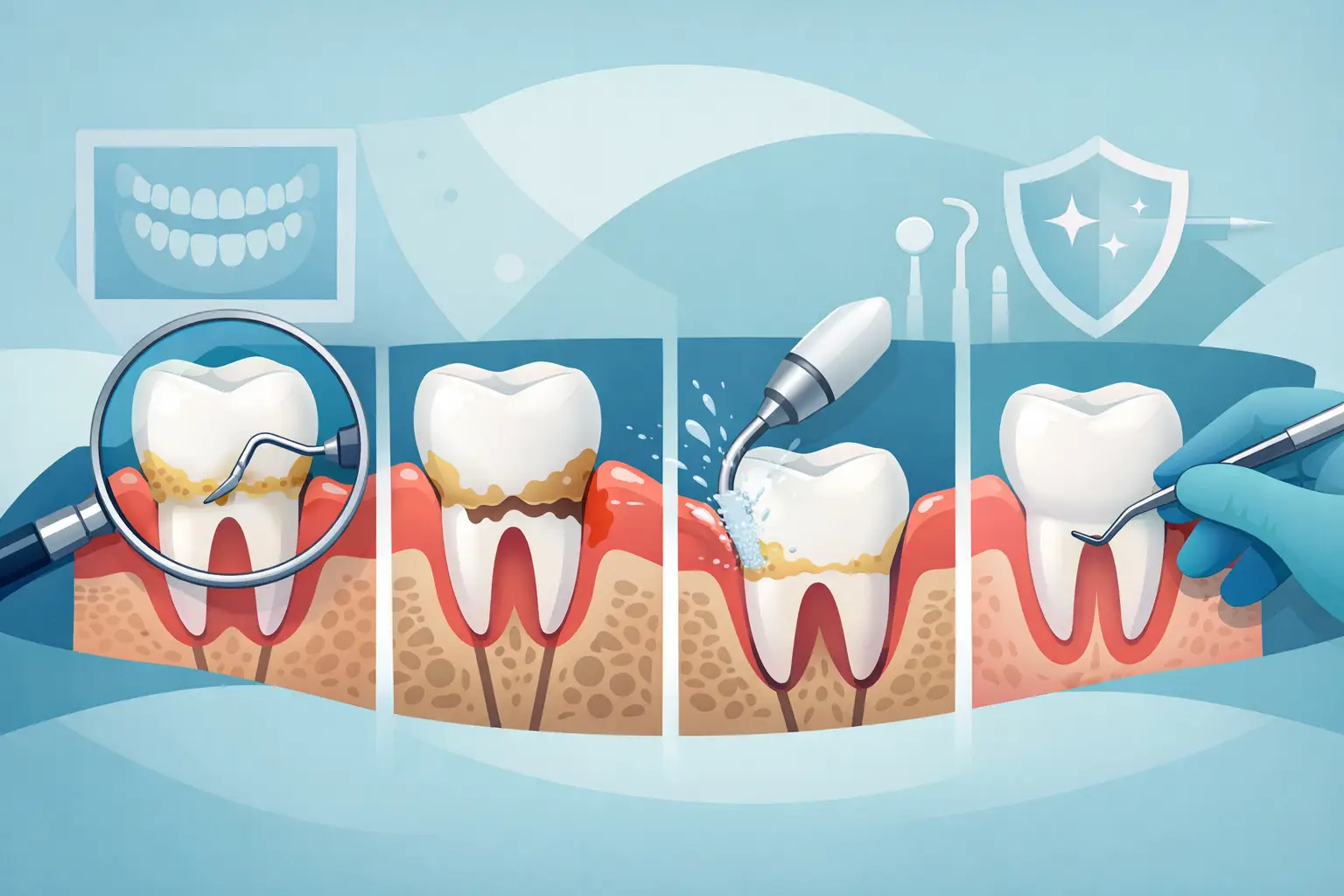
Before any deep cleaning starts, your dentist or hygienist will assess the condition of your gums in detail. This normally includes measuring the depth of the gum pockets around each tooth, checking for bleeding, looking for gum recession, and assessing whether there is any tooth mobility.
X-rays may also be needed to see whether bone loss has occurred beneath the surface. This stage matters because deep cleaning should be targeted. Mild inflammation in one area is managed differently from more advanced periodontitis affecting the whole mouth.
This is also the stage where your clinician explains what can realistically be achieved. Deep cleaning can control infection and help preserve teeth, but it cannot always reverse every visible sign of previous gum damage. Honesty here is important.
2. Treatment planning and preparation
Once the diagnosis is clear, a treatment plan is arranged. Some patients need one longer appointment, while others benefit from treatment split across two or more visits, often by quadrant or half of the mouth. Staging treatment this way can improve comfort and allow the clinician to clean thoroughly.
You may also receive tailored advice before treatment starts. That could include brushing technique, interdental cleaning, smoking advice, or guidance around managing sensitivity. If plaque control at home is poor, deep cleaning will have limited success, so preparation is part of treatment, not an extra.
3. Local anaesthetic for comfort
This stage is often the one anxious patients worry about most, but it is also the point at which treatment becomes much easier. Local anaesthetic is used to numb the area so deposits can be removed from below the gum line without unnecessary discomfort.
Not every patient needs anaesthetic in every area, but many do, especially where pockets are deeper or roots are sensitive. A comfort-first approach helps patients stay relaxed and makes it possible to clean properly rather than rushing through uncomfortable areas.
4. Scaling below the gum line
This is the core of the treatment. Using fine hand instruments, ultrasonic equipment, or a combination of both, the clinician removes plaque, tartar, and bacterial deposits from the root surfaces and from inside the periodontal pockets.
This cleaning goes far deeper than a standard hygiene appointment. The purpose is to reduce the bacterial load and remove the rough, hardened deposits that keep the gums inflamed. If these deposits remain under the gum line, the infection tends to continue quietly, even if the teeth look clean above the surface.
Depending on the level of build-up, this part can take time. Thoroughness matters more than speed.
5. Root planing and smoothing the root surfaces
After the deposits are removed, the root surfaces may be carefully smoothed. This is the root planing part of treatment. The idea is not to scrape the teeth excessively, but to leave a cleaner surface that makes it harder for bacteria to reattach and easier for the gums to settle back against the tooth.
In practical terms, this stage helps create better conditions for healing. It does not mean the gums suddenly re-grow, and it does not repair lost bone. What it can do is reduce inflammation, lessen bleeding, and encourage the pockets to become shallower over time.
6. Review of healing
One of the most misunderstood gum disease deep cleaning stages is the review appointment. Patients sometimes assume the cleaning itself is the end of treatment, but the follow-up is where success is measured.
Usually a review is arranged several weeks later. At that visit, your dentist or hygienist checks whether bleeding has reduced, whether pocket depths have improved, and how well you are managing your home care. Some areas may heal very well. Others may still need further attention.
This is where dentistry becomes less one-size-fits-all. If the disease was caught reasonably early and home cleaning improves, deep cleaning may be enough to stabilise things. If pockets remain deep or inflammation persists, more periodontal treatment may be advised.
7. Ongoing maintenance
Gum disease is a long-term condition that can be managed successfully, but it does need maintenance. Once active infection is under control, regular periodontal maintenance visits help keep it stable.
The interval varies. Some patients need reviews every three months, while others can move to longer intervals. It depends on your gum health, medical history, smoking status, and how effectively plaque is controlled at home. Skipping maintenance often allows the problem to return quietly.
What healing feels like after deep cleaning
Most patients experience mild tenderness for a few days, especially after the numbness wears off. The gums may feel bruised, and the teeth can be more sensitive to cold for a short period. This is common and usually settles.
You may also notice that the gums look slightly less puffy afterwards. That can be encouraging, but it sometimes makes teeth appear a little longer because inflamed tissue is reducing. This is not the treatment damaging the gums. It is often the inflammation resolving and revealing the true gum position.
Good home care during healing is essential. Gentle but thorough brushing, cleaning between the teeth, and following the advice given by your clinician all help the gums recover. If oral hygiene does not improve, the benefit of deep cleaning can be short-lived.
When deep cleaning is enough – and when it is not
For many patients, non-surgical periodontal treatment works well, particularly when gum disease is moderate and addressed in good time. Bleeding can reduce, breath can improve, and the pockets may become easier to manage.
However, there are cases where deep cleaning is only the first step. If very deep pockets remain, if there are difficult root shapes, or if bone loss is advanced, referral for more complex periodontal care may be needed. Occasionally, surgical treatment is recommended to access deeper areas more directly.
That does not mean deep cleaning has failed. It means the disease is more advanced and needs a wider treatment plan.
Questions patients often ask before booking
A very common question is whether deep cleaning hurts. With effective local anaesthetic, treatment is usually very manageable. Afterwards, tenderness and sensitivity are more common than pain.
Another question is whether one appointment will solve everything. Sometimes yes, but often treatment is staged over more than one visit so each area can be cleaned properly. Rushing periodontal treatment rarely produces the best result.
Patients also ask whether the gums grow back. Inflamed gum tissue can tighten and look healthier once infection is controlled, but tissue and bone already lost to periodontitis do not always fully return. The real win is stopping further destruction and keeping the teeth stable for the long term.
At Thurloe Street Dental South Kensington, this kind of treatment is approached with the same priority patients value across all care – calm explanation, gentle technique, and a clear plan for what happens next.
If your gums are bleeding, sore, or pulling away from your teeth, the most useful next step is not to wait for it to settle by itself. Gum disease often progresses quietly, and early treatment is usually simpler, more comfortable, and more predictable.